


Internship Program
Learn about the rainforest and strengthen your field research skills
An overview of our research internships:


Our research-focused internships are designed to provide individuals—students, early-career or aspiring scientists, and others with a deep interest in the tropics—with the chance to learn through direct, hands-on engagement with the Amazon rainforest and our work to study and protect it.
We offer three different programs that vary in length from one to three months.
Each shares a common academic structure that includes an exploration of topics in tropical biology, conservation, and sustainable development through lectures, readings in the primary literature, guided discussions, and guided independent study.
Scroll down to learn more about these exciting opportunities!
Three different options:

What our Interns are saying
"I expected to learn a lot about the Amazon—and I did—but I also learned about myself, people, and the world. Coming here has altered my world view in a positive way."

Maddy Stauder
Posing with an experimental artificial next box constructed for Scarlet Macaws at Finca Las Piedras
"I learned to be creative in many ways. Manual work, constructing traps to catch a tiny fraction of the rich wildlife. Scientific knowledge, putting together information from the literature. All surrounded by—submerged into—this exotic diversity."

Tobias Süess
With a drift fence used to sample reptiles and amphibians across a disturbance gradient
"Even though there was a fair share of struggles when I realized my limitations, the last three months has been a great experience for me. I mean, how can you cross the line if you don’t know where it

Zephyr Dang
Gathering data on native Theobroma (cacoa plants) in one of the ASA's agroforestry plots
2027 Dates, Deadlines & Fees
- | Introduction to Sustainability | Advanced Sustainability | Academic Quarter |
|---|---|---|---|
Duration | 4 Weeks | 8 Weeks | 12 Weeks |
Fee/week | $575 | $495 | $460 |
Total Fee | $2,300 | $3,960 | $5,520 |
Session dates
Session I | May 31 - Jun 25 | May 31 - Jul 23 | May 31 - Aug 20 |
Session II | Jun 28 - Jul 23 | Jun 28 - Aug 20 | Jun 28 - Sept 17 |
Session III | Jul 26 - Aug 20 | Jul 26 - Sept 17 | -- |
Session IV | Aug 23 - Sept 17 | -- | -- |
Application & Payment Deadlines
Session I | Apr 30 | Apr 30 | Apr 30 |
Session II | May 28 | May 28 | May 28 |
Session III | Jun 25 | Jun 25 | -- |
Session IV | Jul 23 | -- | -- |
Please read our Terms and Conditions and our Cancellation Policy before making a payment
Why are there fees for the Internship Program?
We're a medium-size non-profit organization trying to do big work with a small budget. The Internship Program fees mostly cover the cost of housing and food for interns at our field site in Peru, with some also going to cover the cost of the support staff that facilitates the program. This allows us to dedicate our limited resources entirely to our research, reforestation, and education projects in southeastern Peru.
What's covered, and what's not?
Program fees include full room & board, 7 days per week, for the duration of the program at Finca Las Piedras (although interns are only required to work Monday through Friday). Transportation between Finca Las Piedras and the Puerto Maldonado airport (PEM) at the beginning and end of the program is also included, as is full-time supervision by ASA faculty and staff.
Fees DO NOT cover international or local flights, or travel & health insurance. Materials related to intern independent research projects are also not covered.
An application fee of $150 is due after registering for the Internship Program, which is refundable. Please read our Cancellation Policy, as well as our Terms and Conditions for more information before making a payment. You will be given payment options upon completion of the Application Form (available here).
General internship program details
Overview
Program Location: Finca Las Piedras, Madre de Dios, Peru
Accommodations: Shared room/dormitory
Work Schedule: Monday through Friaday, 8 hrs/day
Meeting Location: Puerto Maldonado, Peru

Map of the field site in southeastern Peru

Requirements
An academic background or strong interest in biology, conservation, or sustainable development is highly recommended for all interns. We do not offer academic credit through our organization, but we are happy to sign documents for credit from your home institution. All instruction at the field site is in English. Although Spanish is not required, basic skills will be very useful.
Program faculty and staff
The internship program is overseen by Dr. Geoff Gallice, the ASA’s science director, who has 15+ years of experience working as a research scientist and conservationist in the Neotropics. Interns' primary supervisor and main point of contact is the Academic Programs Coordinator, and support is also provided by our various project managers and team of research assistants and resident naturalists.

Skills developed by interns
All programs:
-
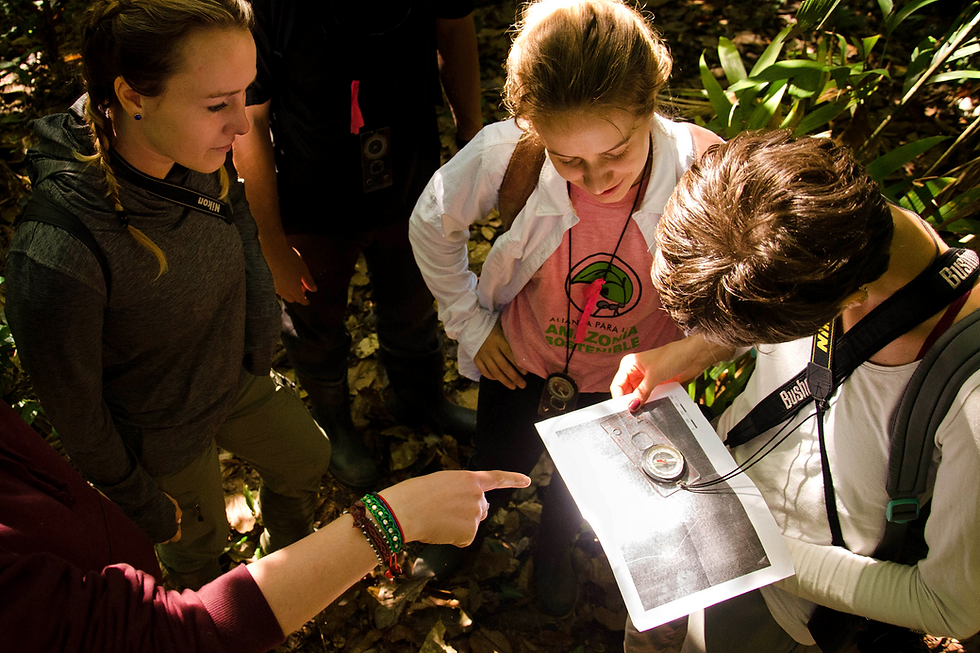
Training in basic field research skills, including off-trail navigation and use of GPS and GIS, techniques used in studies of tropical biodiversity, ecology, and conservation (e.g., experimental design, data collection and management, forest inventory plots, wildlife and insect survey methods, camera trapping, etc.). Training is meant as an introduction to these topics, which interns are then free to further develop independently under the guidance of the program’s leaders.
-
Identification of major Amazonian plant and animal groups (e.g., trees, mammals, birds, reptiles and amphibians, insects and other invertebrates)
-
Tropical reforestation methods and practices
-
Weekly assigned readings on topics covering tropical biology, sustainable development, and conservation, which are discussed as a group during guided sessions
Advanced & Academic Quarter programs:
-
Comprehensive field research methodology through an in-depth, guided independent research project

Example intern activities
Biological research & monitoring
-
Lepidoptera diversity and biology—participate in an ongoing, long-term biodiversity study of butterflies and moths, including butterfly collecting and rearing for host plant records
-
Biological inventories—insects, birds, mammals, trees/plants
-
Plant phenology (fruiting and flowering of select tree species) to monitor changes over time in a changing climate
Reforestation & sustainable agroforestry
-
Reforestation with native species to provide environmentally-friendly alternatives to unsustainable agriculture in our region, including tree planting and plot maintenance
-
Shade house and tree nursery management practices
-
Native food forest monitoring—a future forest of native species with food, building, and/or medicinal uses
Independent Research Project
Overview
As well as the activities listed above, all interns will have the added opportunity to develop an independent research project on a topic of their choosing, under the supervision of our academic faculty. This will allow interns to build upon what they have learned at the beginning of the program and apply it to a project in an area that is novel or interesting to them. Topics may also be assigned in an area of our faculty’s academic expertise, including wildlife biology and ecology, entomology, botany, natural history, reforestation, or sustainable development. This optional project will provide participants with a more thorough insight into the process of scientific discovery and conservation in the tropics. Note that all interns have the option of completing and independent research project, however, those staying two months or more will have the time to develop a more detailed study, including field data collection and analysis.

Successful past projects
-
Assessing the Impact of Timber Extraction on the Habitats of Southeast Peruvian Amazon Primates - Cassie Rodrique, July 2024
-
Quantifying primate range and activity in a disturbed forest - Daniel Schmidt, August 2023
-
Community perspectives in drought and water management in Madre de Dios, Peru - Julia Swain, August 2023
-
Distributions of Galipea trifoliata and Pausandra trinae in a disturbed region of the Peruvian Amazon: Testing the Janzen-Connell explanation for rarity with two common Amazonian Trees – Gabriela Jeliazkov, July 2021
-
An analysis of constraints and opportunities for sustainable inclusion of Madre de Dios farmers in cacao value chains – Mitch Theisen, August 2019.
-
Comparing butterfly diversity in different tropical habitats – Allison Stoiser, August 2018
-
A case study of arboreal termite (Insecta: Isoptera) tree selection at Finca Las Piedras, Madre de Dios, Peru – Declan Cronin, September 2018
-
Wild cacao (Theobroma cacao) survey and mapping at Finca Las Piedras, Madre de Dios, Peru – Zephyr Dang, September 2017
-
Assessing the sustainability of local farming practices in the vicinity of Finca Las Piedras, Madre de Dios, Peru – Joao Vilca, October 2017
-
Discerning diurnal roost preferences of cavity roosting Neotropical bats for the purpose of designing successful artificial bat roosts – Angela Brierly, August 2017
Program objectives
This 4-week program offers participants a broad introduction to biological research and conservation in the tropics. Our teaching and learning approach is both academic and hands-on. After receiving training in basic field skills, interns will participate directly in scientific research and applied conservation projects that span our three focal areas: research, reforestation, and/or education (active projects vary by time of year). With the help of our academic faculty, interns will also navigate tropical biology and conservation science through lectures and weekly reading discussions covering articles drawn from the primary scientific literature. This is an excellent opportunity to explore an exciting variety of potential career paths in biology and conservation under the guidance of experts in those fields.
Independent Research Project:
This program offers the chance to conduct a small independent project, with careful consideration given to the constraint of time in particular.

Details
Dates (2027):
Session I: May 31 - Jun 25
Session II: Jun 28 - Jul 23
Session III: Jul 26 - Aug 20
Session IV: Aug 23 - Sept 17
Application Deadlines:
Session I: Apr 30
Session II: May 28
Session III: Jun 25
Session IV: Jul 23
Program Fees:
Per week: $575
Total fees: $2,300
(4 weeks)
Objective
This 8-week program offers participants a more in-depth survey of biological research and conservation in the tropics. Interns will learn by participating directly in scientific research and applied conservation projects that span our three focal areas: research, reforestation, and/or education (active projects vary by time of year). With the guidance of our academic faculty, interns will also navigate tropical biology and conservation science through lectures and weekly reading discussions covering articles drawn from the primary scientific literature.
Independent Research Project:
As well as the activities listed above, participants in the Advanced Sustainability Internship Program will have the added opportunity to develop an in-depth Independent Research Project on a topic of their choosing, under the supervision of our academic faculty. Topics may also be assigned in an area of our faculty’s academic expertise, including wildlife biology and ecology, entomology, botany, natural history, reforestation, and sustainable development. This optional project will provide participants with a more thorough insight into the process of scientific discovery and conservation in the tropics.
Details
Dates (2027):
Session I: May 31 - Jul 23
Session II: Jun 28 - Aug 20
Session III: Jul 26 - Sept 17
Application Deadlines:
Session I: Apr 30
Session II: May 28
Session III: Jun 25
Program Fees:
Per week: $495
Total fees: $3,960
(8 weeks)
Objective
This 12-week program offers participants the most thorough exploration of biological research and conservation in the tropics. Interns will learn by participating directly in scientific research and applied conservation projects that span our three focal areas: research, reforestation, and/or education (active projects vary by time of year). With the guidance of our academic faculty, interns will also explore topics tropical biology and conservation science through lectures and weekly reading discussions covering articles drawn from the primary scientific literature.
Independent Research Project
As well as the activities listed above, participants in the Academic Quarter Internship Program will have the added opportunity to develop a detailed Independent Research Project on a topic of their choosing, under the supervision of our academic faculty. Topics may also be assigned in an area of our faculty’s academic expertise, including wildlife biology and ecology, entomology, botany, natural history, sustainable agroforestry, and community development. This optional project will provide participants with a more thorough insight into the process of scientific discovery and conservation in the tropics. The Academic Quarter Internship Program is ideal for those wishing to maximize their learning experience in the rainforest or intending to complete an academic thesis, particularly at the undergraduate level (i.e., capstone).

Details
Dates (2027):
Session I: May 31 - Aug 20
Session II: Jun 28 - Sep 17
Application Deadlines:
Session I: Apr 30
Session II: May 28
Program Fees:
Per week: $460
Total fees: $5,520
(8 weeks)
Where you'll live and work
Finca Las Piedras is our research and education center located in Peru's Madre de Dios region. This is where our interns, as well as our full-time staff and other visitors live and work in the heart of the Peruvian Amazon rainforest.
Facilities include dormitories, a shared dining hall, and multiple spaces for work and play. In addition, the site offers easy access to a variety of Amazonian ecosystems via an extensive trail network, as well as active and abandoned agricultural land in the vicinity of the Interoceanic Highway. Finca Las Piedras, therefore, is strategically located and well set up to maximize opportunities for research and learning.
Visit the Finca Las Piedras page to learn more about the site, its amenities, and its incredible biodiversity.
Learn more about Finca Las Piedras here.


